



Minister of Science and Technology Nguyen Manh Hung
In his recent interview ahead of the 14th National Party Congress, Minister Nguyen stressed that Viet Nam has laid the foundations for a new development framework in which science and technology, innovation and digital transformation shall be promoted and evaluated on the basis of outputs and impacts on socio-economic development. The entire chain of research–application–commercialization shall center around solving development challenges, rather than operating in a fragmented manner.
These aforesaid change of mindset has taken tangible shape, most clearly reflected in three dimensions.
First, Viet Nam has focused on removing bottlenecks so that science and technology can be rapidly translated into daily life as well as production and business activities. In the final year of the term alone (2025), the volume of legislative work was substantial and left a clear imprint.
The Ministry of Science and Technology took the lead, in coordination with relevant agencies, in drafting, amending and submitting to the National Assembly 10 laws and one resolution. At the level of the Government and the Prime Minister, 23 decrees, one resolution and five decisions drafted under the Ministry's leadership were signed and promulgated. This policy framework demonstrates strong determination to "unlock" institutional bottlenecks—one of the biggest barriers to the development of science, technology and innovation over many years.
Second, digital infrastructure and digital governance capacity have been significantly strengthened and earned international recognition.
According to the United Nations, Viet Nam climbed 15 places in the 2024 on the E-Government Development Index, ranking 71st out of 193 countries. In telecommunications, Viet Nam's Internet speed has risen sharply, placing it among the regional leaders and within the global top 10–15 according to international rankings. 4G coverage exceeds 99.8 percent, 5G reaches more than 91 percent of the population, 100 percent of communes and wards have fiber-optic broadband infrastructure, fiber coverage to households stands at 87.6 percent, and smartphone penetration is estimated at over 85 percent. These figures show that Viet Nam has moved from mere "digitalization" to "data-driven operations," with digital infrastructure becoming a foundation for enhancing governance effectiveness and reducing costs for citizens and businesses.
Third, innovation capacity and the startup ecosystem have been strengthened, contributing to enhancing the national competitive position.
Viet Nam ranks 44th globally on the Global Innovation Index and is recognized as one of the nine middle-income countries with the fastest improvement in rankings over the past decade.
"The most valuable outcome of the 2021–2025 period is not just the figures, but the momentum of transformation that has been established: innovation embedded in business operations, digital transformation integrated into the functioning of the economy, and results-based governance gradually becoming the norm," Minister Nguyen stressed.
Advances benefit citizens and businesses
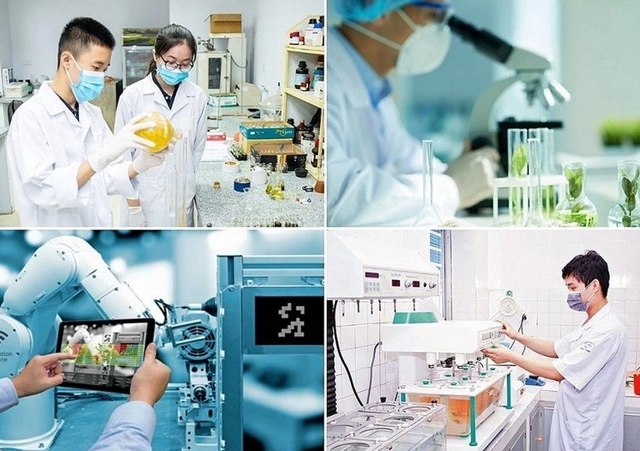
Over the past five years, concrete changes in the science, technology and innovation sector have brought clear benefits to both citizens and businesses, from administrative procedures and public services to production capacity and product quality.
First is the change in how the State serves citizens and businesses. Administrative procedures and public services have become more convenient and transparent thanks to digital transformation. Paperwork has been reduced, travel minimized, and waiting times shortened. By 2025, the share of fully online dossiers among total dossiers for fully online public services reached nearly 78 percent, while the proportion of public services generating online dossiers stood at nearly 84 percent. These figures indicate that the handling of administrative procedures is shifting strongly from "queuing and waiting" to the digital environment.
The capacity and productivity of enterprises have also improved markedly and in greater depth through the application of technology and process innovation. Automation, digital management and data utilization enable businesses to optimize operations, shorten production cycles, reduce errors, save materials and energy, and enhance supply chain efficiency.
From the citizens' perspective, as digital transformation becomes more comprehensive, the digital space is emerging as a new living space, where essential services in education, healthcare, finance, commerce and beyond are delivered quickly and in a personalized manner, ensuring that everyone can participate in and benefit from the digital environment.
Citizens benefit in convenience, businesses benefit in productivity and quality, and the State benefits in governance capacity. This is the most tangible measure of the role of science, technology and innovation in daily life.

Outstanding products are on display at the national exhibition themed “80-Year Journey of Independence – Freedom – Happiness” at the National Exposition Centre in Dong Anh commune, Ha Noi, September 14, 2025 - Illustration photo
Identifying strategic solutions
The new growth model highlighted by the 14th National Party Congress places science and technology, innovation and creativity at the center of socio-economic growth, shifting them from a sector-specific role to a cross-cutting driver of national development. To realize the goals of sustained double-digit growth, science, technology and innovation must translate macro-level objectives into productivity gains, growth quality and competitiveness through strategic solutions.
First is institutional reform. Institutions must move ahead to pave the way for innovation. A legal framework needs to be developed for key priority fields, alongside the implementation of controlled pilot and sandbox mechanisms. Law-making approaches must also change: science and technology evolve rapidly, and legislation cannot wait five to ten years for revision; where necessary, adjustments should be made annually, with one or two critical provisions revised each year.
Second is mastering strategic technologies and emerging industries. Viet Nam must remain steadfast on the path of self-reliance and self-resilience, gaining control over core technologies. Priority resources should be concentrated on semiconductors, artificial intelligence, UAVs, advanced materials and new energy, while gradually developing capabilities in space and quantum industries. These are new growth poles that will determine the country's position and competitiveness in the next stage of development.
Third is a fundamental reform of the management model for national science and technology programs and financial mechanisms, with results as the key metric. This entails a strong shift from "spending on research" to "commissioning and purchasing research outcomes," and from input-based management to output-oriented investment. At the same time, intellectual property and standards should be treated as tools to guide development.
Fourth is the development of modern science and technology infrastructure and digital infrastructure. The focus should be on national shared data platforms, data centers, high-performance computing and AI centers, a system of key laboratories, and a modern, synchronized postal and telecommunications infrastructure.
Finally, it is essential to develop a science, technology and innovation ecosystem anchored in talent. Without talent, there can be no strong science; without strong science, there can be no strong nation. Policies must be robust enough to attract and retain top talent; effectively implement the "triple-helix" model, with enterprises at the center, research institutes and universities as the core, and the State as the enabler; and unlock capital flows for innovation, particularly through public–private venture capital funds./.
