

Viet Nam ranks 43rd globally in innovation, leading the world in two key indicators
<p style="text-align: justify;">Viet Nam has moved up one spot to rank 43rd out of 139 economies in global innovation for 2026. Notably, its innovation outputs advanced by two positions, driven by two high-tech export indicators that lead the world.</p>
On the afternoon of September 29, 2026, the World Intellectual Property Organization (WIPO) released the Global Innovation Index (GII) 2026 Report in Geneva, Switzerland.
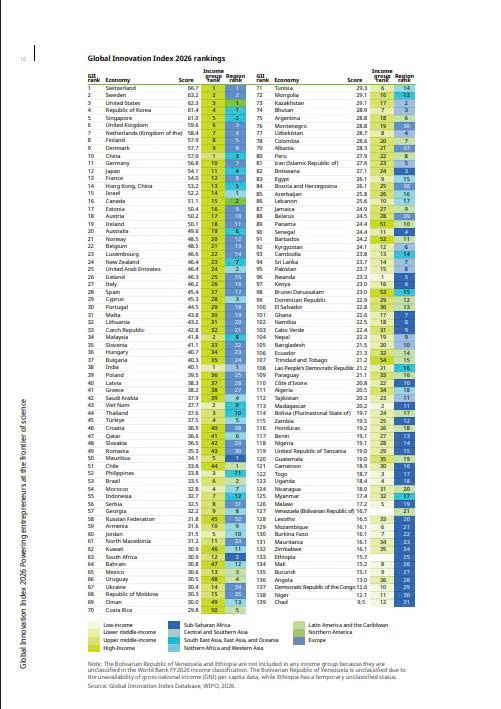
According to the report, Viet Nam ranks 43rd among 139 countries and economies, rising one place compared to 2025 and achieving the target set by the Government in Resolution No. 02/NQ-CP for 2026.
Viet Nam ranks 43rd globally in innovation, leading the world in two key indicators
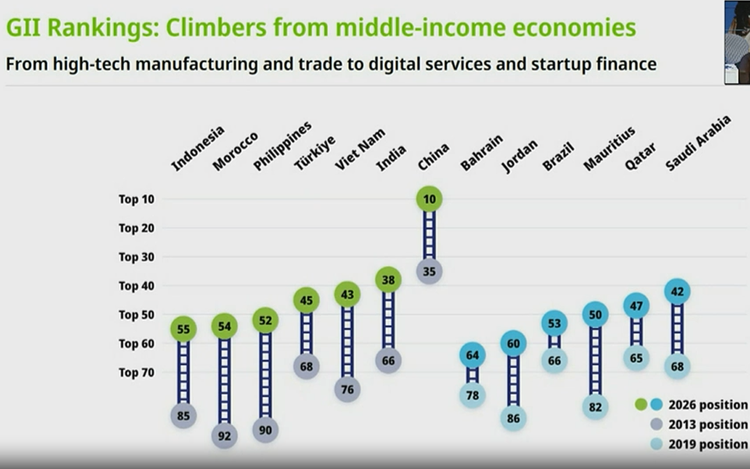
Over the past decade, Viet Nam’s GII position has climbed 16 spots, up from 59th in 2016 to 43rd in 2026.
Viet Nam continues to secure second place among lower-middle-income economies, following India at 38th. Among the economies ranked above Viet Nam, China holds 10th position and Malaysia ranks 34th - both belonging to the upper-middle-income group - while all remaining higher-ranked economies are classified as high-income.
Within ASEAN, Viet Nam ranks third, behind Singapore (5th) and Malaysia (34th), and ahead of Thailand (44th), thereby surpassing the Government's target set in Resolution No. 01/NQ-CP for 2026. Furthermore, Viet Nam remains among the seven middle-income economies making the fastest progress since 2013, maintaining a 16-year continuous record of innovation performance exceeding its level of development.
The GII is an annual index published by WIPO that assesses the innovation capabilities and performance of economies. It measures both input conditions -institutional framework, human capital and research, infrastructure, market sophistication, and business sophistication - and outputs spanning knowledge, technology, and creative outputs.
In Viet Nam, the GII serves as a key tool for national governance and administration. Ministry of Science and Technology acts as the lead agency monitoring, coordinating, and collaborating with ministries, sectors, and local authorities to propose measures for enhancing national innovation capacity. According to WIPO surveys, 93 member states utilize GII findings to formulate science, technology, and innovation strategies and policies.
Innovation outputs advance two places
A standout highlight in this year's results is the two-place rise in Viet Nam's innovation outputs, moving from 37th to 35th. Within this category, the Knowledge and Technology Outputs pillar gained four places, rising from 39th to 35th. This improvement directly contributed to the elevation of Viet Nam’s overall GII ranking.
Minister of Science and Technology Vu Hai Quan evaluated the two-spot rise in innovation outputs as a commendable achievement, demonstrating that policies and resources allocated to this sector are beginning to yield tangible results.
According to Minister Vu Hai Quan, these outcomes stem from the decisive implementation of Resolution 57 over the past year. Investment resources dedicated to science, technology, innovation, and digital transformation have grown substantially, while the policy and legal framework continues to be refined.
The active participation of the State, enterprises, research institutes, and universities has also contributed to the initial formation of a robust national innovation ecosystem.
The management approach to science, technology, and innovation is shifting from input-heavy monitoring to results-based management focused on final outcomes and practical efficacy. Priority resources are being directed toward research and development (R&D), high technology, strategic technologies, and areas capable of generating high-impact national development.
Two indicators lead the world
In 2026, Viet Nam maintains its world-leading positions in high-tech exports as a proportion of total trade and creative goods exports as a proportion of total trade.
Three additional indicators rank within the global top 10: high-tech imports as a percentage of total trade (3rd); total mobile app creation and use (5th); and labor productivity growth rate (6th).
Viet Nam also holds strong positions in GERD financed by business enterprises (13th); domestic credit to private sector (14th); tariff rate, weighted average (15th); and gross capital formation alongside production diversification (both tied at 19th).
Several innovation input indicators experienced substantial gains. ICT access moved up 11 spots to 66th. Finance for startups and scaleups rose six places to 44th, while later-stage venture capital deals climbed two places to 40th.
University-industry R&D collaboration advanced seven places to 24th. The proportion of researchers employed in business enterprises rose two spots to 49th.
On the output side, patent applications by origin climbed three places to 63rd. High-tech manufacturing output advanced one spot to 25th, while production and export complexity rose eight places to 44th.
Global brand value climbed one place to 28th, and industrial design applications advanced three spots to 48th.
Innovative enterprise activities achieved notable results, marked by three unicorns valued at over 1 billion USD and the emergence of deep-tech science startups. R&D investments showed initial signs of improvement, alongside progress in higher education research and industry collaboration.
Input decline and high-quality human resources bottleneck
While outputs improved, Viet Nam's innovation input ranking dropped four places, falling from 50th to 54th.
The Institutions pillar dropped from 59th to 64th; Human Capital and Research fell from 70th to 79th; and Infrastructure slid from 56th to 59th. Market Sophistication retained its position at 43rd, whereas Business Sophistication declined from 45th to 48th. The Creative Outputs pillar eased by one spot to 35th.
These findings indicate that while Viet Nam possesses a strong capacity to convert inputs into positive innovation outputs, its foundational pillars - institutions, human capital, research, infrastructure, and capital availability - require sustained strengthening.
Expenditure on education as a percentage of GDP ranks 112th; pupil-teacher ratio in secondary education stands at 106th; tertiary enrollment rate at 87th; inbound mobility rate of international university students at 111th; and tertiary graduates in science and engineering at 65th.
Knowledge-intensive employment in the enterprise sector ranks 85th; employment in knowledge-intensive services stands at 100th; and female employment with advanced degrees ranks 84th.
Venture capital flows have yet to demonstrate stable upward momentum. Two of the three venture capital indicators dropped compared to 2025, causing the overall venture capital sub-index to slip six places to 68th.
Knowledge absorption from foreign enterprises remains limited. ICT services imports stand at 134th. Rule of law enforcement ranks 81st, while regulatory quality - despite rising four places - remains low at 91st.
Knowledge outputs also show constraints. Citable scientific and technical articles rank 106th; charges for the use of intellectual property payments stand at 110th; and ICT services exports rank 103rd.
Crucial need for active enterprise involvement
Under the Science, Technology, and Innovation Development Strategy approved via Decision No. 604/QD-TTg dated April 2, 2026, Viet Nam aims to break into the top 40 GII economies by 2030. Furthermore, Resolution 57 sets a long-term goal for Viet Nam to join the top 30 global innovation leaders by 2045.
According to Minister Vu Hai Quan, Viet Nam must address several critical tasks to fulfill these dual objectives:
First and foremost is upgrading the quality of human capital, particularly high-caliber talent for strategic technology industries and post-graduate degree holders.
Viet Nam must also step up international scientific publications and accelerate patent filings, both of which serve as direct metrics of innovation capability.
The Minister emphasized the imperative need to deepen business engagement in innovation and R&D activities. Vietnamese enterprises must invest more aggressively - in both financial and human capital - to systematically integrate high technology and digital transformation into production and business operations, thereby upgrading product quality, enhancing value addition, and driving labor productivity.
Minister Vu Hai Quan stressed that only when the corporate sector fully commits and takes the lead will Viet Nam be able to realize its innovation targets for 2030 and 2045.
In its capacity as the national focal point monitoring and driving GII improvements, Ministry of Science and Technology will continue refining institutional frameworks based on practical demands, stimulating R&D investments, and attracting multinational corporations to establish R&D centers and expand investments in high-tech and strategic technologies across Viet Nam.
Other key tasks include mobilizing capital for tech startups, forming innovation clusters and linkages, developing tech enterprises, and assisting domestic businesses in acquiring, absorbing, and mastering advanced technologies to enhance national productivity and economic competitiveness./.