

Resolution spurs digital transformation as localities turn policy into action
<p style="text-align: justify;">A wide range of digital models and digital knowledge initiatives have been rolled out, generating tangible momentum in socio-economic development and accelerating the spread of digital transformation across communities.</p>

Delegates launch the Advanced Packaging Technology Manufacturing Laboratory (Fab-Lab) project in Đà Nẵng on July 28, 2025. Photo: VNA
One year after the implementation of a Politburo resolution on developing breakthroughs in science and technology, innovation and national digital transformation, many localities have swiftly translated the policy into concrete roadmaps and action plans.
A wide range of digital models and digital knowledge initiatives have been rolled out under Resolution 57-NQ/TW, generating tangible momentum in socio-economic development and accelerating the spread of digital transformation across communities.
A strategic lever for sustainable growth
In Đà Nẵng, Resolution 57 has been identified as a foundational pillar for the city’s new development phase in the digital era. Its start-up and innovation ecosystem has climbed 130 places in the global rankings, reaching 766th among the world’s top 1,000 cities.
The city was recognised by StartupBlink as Việt Nam’s fastest-growing start-up ecosystem and was also named among the country’s top 10 localities for innovation ecosystem development at Techfest Việt Nam 2025.
Đà Nẵng’s science and technology sector has recorded notable breakthroughs in high-tech industries, semiconductor microchips and digital infrastructure. Key milestones include the inauguration of the Đà Nẵng Software Park 2 and the launch of the Advanced Packaging Technology Laboratory project.
Alongside these efforts, the central city has accelerated the development of digital infrastructure for its two-tier local government system, strengthened the operations of community digital technology teams, prioritised workforce training and promoted science and technology literacy through initiatives like the Digital Literacy for All movement, the Popular AI Learning series and student-led scientific research activities.
In Khánh Hòa, following its merger with Ninh Thuận Province, the locality has brought together favourable timing, geographic advantages and a high-quality workforce.
Scientific research, technology development and innovation have seen strong momentum, with the number of proposed science and technology tasks in 2025 tripling compared with previous years. The province ranked ninth out of 34 cities and provinces nationwide in the 2025 Provincial Innovation Index.
In April 2025, Khánh Hòa became the first province to research and deploy a comprehensive KPI software toolkit to digitise performance evaluations for officials and civil servants.
The provincial data centre now operates at two sites in Nha Trang and Phan Rang, equipped with synchronised servers, storage and networking systems that meet security and safety requirements. The province has completed the first phase of its Smart Monitoring and Operations Centre and established a cybersecurity operations centre for provincial information systems.
These data and smart governance platforms enable multi-sectoral data analysis, support early problem detection, facilitate timely decision-making and enhance transparency and management efficiency.
Digital transformation from the ground up
Following the adoption of the two-tier local government model, many localities have identified the consolidation and strengthening of Community Digital Technology Teams as a key task to ensure organisational coherence, improve operational effectiveness and meet the requirements of Resolution 57.
With a network covering all villages and residential groups and more than 24,000 members, these teams, along with Project 06 on population data, digital identification and authentication for national digital transformation, support digital transformation steering committees at all levels in bringing digital skills and services closer to the public.
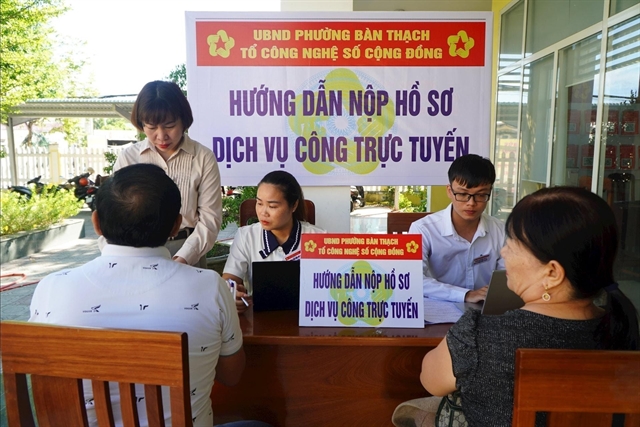
Members of Community Digital Technology Teams in Đà Nẵng help residents submit online public service applications. Photo: VNA
Across Đà Nẵng, all 93 localities (excluding the Hoàng Sa special zone) have established Community Digital Technology Teams. Each village and residential group has an active team, bringing the citywide total to 3,766 teams with nearly 24,303 members.
These teams also spearhead the Digital Literacy for All movement in conjunction with digital learning within neighbourhood activities, helping ensure that digital transformation moves beyond policy into everyday life, particularly for vulnerable groups with limited access to technology.
According to the Steering Committee for Science, Technology, Innovation and Digital Transformation of Lào Cai Province, the province completed 100 per cent of the 167 tasks assigned by central authorities in 2025, placing it among the highest-performing localities nationwide in implementing Resolution 57.
Suối Chải Village in Bát Xát District is the latest site to pilot the Digital Village model in Lào Cai. This mountainous border village faces severe hardship, with all households belonging to ethnic residents. It has 86 households and 440 residents, with poor households accounting for around 75 per cent.
The model supports residents in accessing online public services at the village, using chip-based citizen ID cards and digital utilities, operating electronic party member handbooks, conducting party cell activities on digital platforms and organising online meetings through a synchronised system of cameras, large-screen televisions, computers and internet-connected devices.
In Lào Cai, digital transformation has also empowered farmers to apply information technology, social media and e-commerce in production and business. Many now use smartphones to photograph and film products, promote them online, connect with markets and sell local agricultural products on e-commerce platforms, gradually building brands and expanding market reach.
Where citrus fruits were once largely imported from across the border, Mường Khương mandarins are now firmly established in the domestic market and distributed nationwide through e-commerce platforms, social networks and modern distribution systems.
These practical outcomes across localities reaffirm Resolution 57-NQ/TW as a powerful catalyst and a solid stepping stone, enabling localities to deploy digital solutions and effectively harness their inherent potential and advantages for fast and sustainable development. /.