

Five major orientations to boost strategic tech cooperation between Viet Nam and Russia
<p style="text-align: justify;">In the framework of his State visit to Russia, on the morning of September 9, 2026, in Moscow, General Secretary and State President To Lam and the high-ranking Vietnamese delegation attended the Viet Nam – Russia Science and Technology Forum themed "Connecting strategic technologies".</p>
The forum took place as Viet Nam and Russia actively enhance cooperation across multiple fields. Science, technology, innovation, and human resource development have been identified as domains with significant potential and space for collaboration.
Speaking at the forum, General Secretary and State President To Lam emphasized that Viet Nam is entering a new stage of development, aiming to become a developing country with modern industry and upper-middle income by 2030, and a developed, high-income country by 2045.
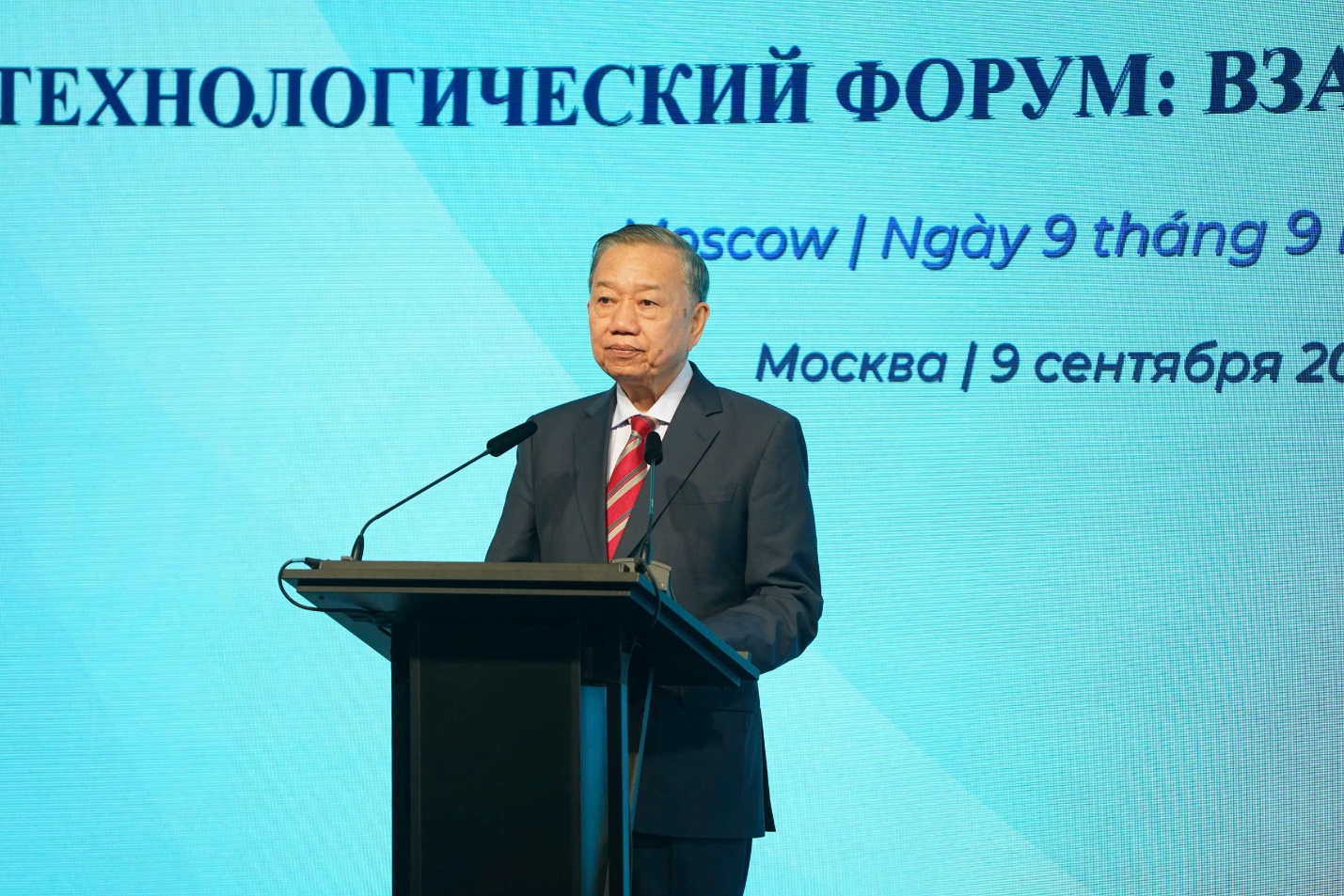
General Secretary and State President To Lam delivers a keynote address at the forum.
To achieve these goals, Viet Nam identifies science, technology, innovation, and digital transformation as the main drivers to reform the growth model, improve labor productivity, competitiveness, and economic autonomy, in line with Resolution No. 57-NQ/TW dated December 22, 2024, of the Politburo.
Throughout its development process, Viet Nam attaches great importance to international cooperation, particularly with partners possessing strong scientific and technological foundations, traditional friendly relations, and the ability to complement Viet Nam's development needs. Russia is one such partner.
The relationship between Viet Nam and Russia has been built and nurtured over many decades, with science, technology, and education serving as vital foundations. Tens of thousands of Vietnamese officials and experts were trained in the former Soviet Union and present-day Russia; many later became leaders, scientists, and experts who made significant contributions to national construction and development.
According to General Secretary and State President To Lam, in this new period, both sides share the responsibility to elevate this valuable foundation of cooperation to new heights, aligned with the demands of the modern era.
The General Secretary and State President stressed that "Viet Nam - Russia scientific and technological cooperation in the coming period requires new thinking, new approaches, and higher targets." Accordingly, cooperation must extend beyond expert exchanges and personnel training to focus on jointly mastering technologies, co-creating products, and together entering markets.
To realize this objective, the General Secretary and State President proposed that both sides focus on five major orientations:
First, elevating strategic technology cooperation into a vital new pillar of the Viet Nam - Russia Comprehensive Strategic Partnership.
The two countries need to select several truly strategic fields, combining the scientific and technological strengths of Russia with Viet Nam's development demands, human resources, and market potential.
Fields suggested by the General Secretary and State President include nuclear energy, new energy, space and satellite technology, semiconductors, microelectronics, quantum technology, and artificial intelligence.
Selection should aim at areas capable of generating new technological capabilities, directly contributing to socio-economic development, ensuring security and safety, and enhancing the technological autonomy of each nation.
Second, constructing large-scale scientific and technological programs and projects that serve as symbols of Viet Nam - Russia cooperation in the new era.
The General Secretary and State President noted that a new development phase requires new joint works and cooperative programs so that future generations can witness the concrete achievements of bilateral relations.
On this basis, both sides should research and build joint strategic technology programs, shared research centers or laboratories, and establish projects involving research institutes, universities, and enterprises from both countries.
The Nuclear Science and Technology Research Center is viewed as an exemplary illustration of this direction.
Third, placing enterprises at the center of science, technology, and innovation cooperation.
According to the General Secretary and State President, scientific research only generates true development power when its results are transformed into technologies, products, and production capabilities.
Therefore, the leader expressed his desire for Russian technology and energy corporations to boost investment and technology transfer in Viet Nam, while encouraging Vietnamese technology enterprises to proactively seek investment and collaboration opportunities in Russia.
Both sides need to create favorable conditions for scientists and businesses to meet, exchange, and partner; promote the sharing, mobilization, and efficient use of capital and resources for research, development, and technology commercialization.
This requirement aims to bridge the gap from laboratories to factories, and from research outcomes to products and markets.
Fourth, investing strongly in the young generation of Vietnamese and Russian scientists and experts.
"The greatest asset of our bilateral relationship is not only the structures we have built, but also our people," the General Secretary and State President emphasized.
The two sides should expand training programs in strategic technology fields; increase exchanges of young scientists, postgraduate researchers, and engineers; and enable young research groups from both countries to carry out joint scientific and technological tasks.
The goal is to shape a new generation of Vietnamese and Russian scientists who inherit the valuable tradition of cooperation while possessing the capacity to solve 21st-century global technological challenges.
Fifth, establishing concrete and measurable organizational mechanisms.
General Secretary and State President To Lam requested that the governments and relevant agencies of both countries continue to leverage the role of the Viet Nam - Russia Education, Science, and Technology Cooperation Committee, while researching mechanisms for regular reviews of key scientific and technological projects.
Each program must clearly define its objectives, implementing partners, resources, deliverables, and timelines.
In particular, the leader stressed an overarching requirement from commitments to results: signed agreements must be turned into programs; programs into projects; projects into technologies and products; and promising products must be granted market access.
This is considered a new approach to enhance the substance, efficiency, and measurability of bilateral scientific and technological cooperation.
General Secretary and State President To Lam commended agencies and organizations from both countries for announcing concrete cooperation outcomes at the forum regarding joint research, collaboration between science funds, workforce training, atomic energy, nuclear research, and innovation.
However, he noted that the crucial task is to turn these results into a regular, continuous flow of collaboration rather than isolated projects.
The General Secretary and State President requested that Viet Nam's Ministry of Science and Technology work closely with Russian Ministry of Science and Higher Education and relevant agencies of both countries immediately following the forum to select projects viable for early deployment and draw up detailed implementation plans.
In the coming years, the assessment of Viet Nam - Russia S&T cooperation should be judged by more substantive results, rather than merely the number of delegation exchanges or signed documents.
Accordingly, attention must be paid to specific questions: How many technologies have both sides jointly mastered? How many products have been created? How many enterprises have co-invested? How many young scientists have grown? And how have these results contributed to each country's development?
These must serve as the new metrics for Viet Nam - Russia scientific and technological cooperation in the new era, thereby driving breakthroughs in strategic technology cooperation and making the Viet Nam - Russia Comprehensive Strategic Partnership increasingly strong, substantive, effective, and sustainable.
General Secretary and State President To Lam expressed confidence that with a solid political foundation, high political trust, Russia’s scientific and technological potential and Viet Nam's strong determination for reform and development, cooperation in science, technology, and innovation can fully become a new driver, a new pillar, and a new symbol in Viet Nam - Russia relations in the 21st century.