



Deputy Minister of Science and Technology Le Xuan Dinh
Speaking at the Viet Nam-Japan Semiconductor Symposium 2026 (VJSS), Deputy Minister of Science and Technology Le Xuan Dinh highlighted the complementary advantages of the two economies. Japan possesses strong technical expertise, particularly in semiconductor materials, manufacturing equipment, precision production, and quality control. Meanwhile, Viet Nam boasts a young labor force, an expanding electronics manufacturing base, and strong determination to advance its semiconductor industry.
From complementary advantages to a long-term semiconductor cooperation program
According to Deputy Minister Le Xuan Dinh, this is not merely about training engineers, but about building a foundation to foster research and technology transfer, gradually enabling Vietnamese enterprises to integrate deeper into the global semiconductor supply chain.
The Viet Nam-Japan Comprehensive Strategic Partnership provides a favorable framework for both sides to expand cooperation in this field. Notably, cooperation should not stop at sending Vietnamese individuals to study abroad or attracting Japanese corporate investments, but must aim to establish an interconnected ecosystem encompassing training, research, business, and manufacturing.
This approach aligns with the unique nature of the semiconductor industry, where competitiveness hinges heavily on human resource quality, research capabilities, and the capacity to translate knowledge into commercial products.
Training beyond engineers: aligning with semiconductor value chain demands
One of the notable proposals by Deputy Minister Le Xuan Dinh is the establishment of a long-term cooperation program for semiconductor workforce development meeting international standards. This includes expanding postgraduate training links, faculty exchanges, and internship opportunities within enterprises.
This underscores that the requirement for semiconductor personnel is not simply about increasing quantity. The more critical issue is providing training aligned with the exact capabilities required by enterprises and the supply chain.
Viet Nam aims to train 50,000 personnel with university degrees or higher for the semiconductor industry by 2030. However, challenges regarding quality, practical training facilities, and faculty resources remain to be addressed.
Therefore, cooperation with Japan can serve as a vital "bridge," allowing students to gain exposure to real-world production environments and advanced technologies, providing faculty members opportunities for professional exchanges, and enabling businesses to participate directly in curriculum development.
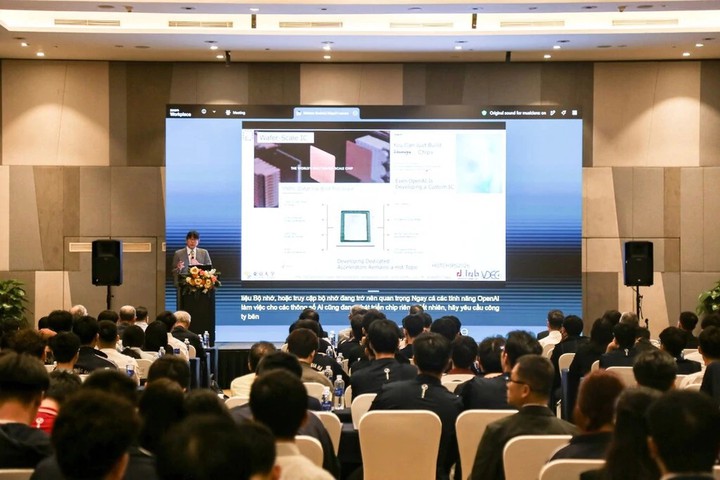
The symposium brought together over 150 delegates, including scientists, experts, technology enterprises, regulatory agencies, and innovation organizations in the semiconductor sector from Viet Nam and Japan.
From laboratories to commercial products
Another critical point is promoting joint research linked with strategic products, forming strong research groups, and establishing joint laboratories. This represents a shift from educational cooperation to technology capacity building.
In the semiconductor field, the gap between research achievements and commercial products is substantial. If universities and research institutes produce scientific findings without enterprise adoption, technology struggles to reach production lines. Conversely, if enterprises rely solely on imported technology, developing long-term autonomous capacity will remain difficult.
Hence, the proposal to establish clear mechanisms for intellectual property and technology transfer holds special significance. When the rights and benefits of scientists, universities, enterprises, and investors are clearly defined, research outcomes can advance to testing, production, and commercialization.
This direction aligns with ongoing Viet Nam-Japan science and technology cooperation programs. In September 2026, Deputy Minister Le Xuan Dinh noted that the Nexus Program between Viet Nam and the Japan Science and Technology Agency (JST) is working toward co-funding research in areas such as design, materials, supporting technology, and semiconductor manufacturing.
Investment must accompany technology transfer and local enterprise development
Semiconductor cooperation cannot be measured solely by the number of investment projects. Viet Nam aims to attract high-quality investment from Japanese enterprises while supporting domestic companies in entering the supply chain. This is the pivotal factor in converting investment capital into domestic production capacity.
If Japanese firms invest in Viet Nam while the supply chain remains largely external, the spillover effects on technology and local corporate capacity will be limited. Conversely, if Viet Namese enterprises can become suppliers of components, materials, equipment, technical services, or participate in high value-added stages, the domestic semiconductor ecosystem will be strengthened.
Thus, human resource training and investment attraction must be designed as two complementary pillars of a single strategy. Enterprises must engage in training; academic institutions must align with production needs; and research must address specific technological challenges.
Enhance the Value of Cooperation
At the event, Assoc. Prof. Dr. Bui The Duy, Director of Viet Nam National University, Hanoi (VNU), stated that the Viet Nam-Japan University (VJU) aims to become a Viet Nam-Japan hub connecting training and research in the semiconductor field, bringing together research institutes, scientists, and businesses from both nations.
VNU leadership shared that the university is developing the National Support Center for Integrated Circuit Design, Fabrication, and Testing, serving as a shared platform for training, research, and semiconductor collaboration. Through VJU, Japanese partners can participate in this ecosystem, collaborating with Viet Nam on joint research activities, technology development, and the establishment of semiconductor laboratories.
According to Japanese Ambassador to Viet Nam Ito Naoki, jointly developing human resources holds great value for the future of the semiconductor industry in both nations. "There is a need for advanced research facilities, appropriate equipment, access to knowledge, as well as opportunities for collaboration between researchers and enterprises of the two countries," Mr. Ito Naoki stated at the event.
This marks the second edition of VJSS, following the inaugural symposium held in Osaka, Japan late last year. The symposium gathered over 150 delegates, including scientists, experts, technology companies, regulatory bodies, and innovation organizations in the semiconductor field from Viet Nam and Japan. Co-organized by Viet Nam Japan University (VJU) – VNU and the Vietnamese Academic Network in Japan (VANJ), the event served as a forum for networking and professional exchange among educational institutions, researchers, and enterprises in the semiconductor sector across both nations./.
