


Viet Nam and Singapore enjoy a truly special cooperative relationship.
Over the past decades, we have built strong bridges in investment, trade, industry, and people-to-people exchanges. A clear symbol of this success is the Viet Nam - Singapore Industrial Park (VSIP).
Following General Secretary To Lam’s State Visit to Singapore and the elevation of our bilateral relations to a Comprehensive Strategic Partnership, a new question needed to be asked: If VSIP was the symbol of Viet Nam - Singapore economic cooperation in the past, what will be the symbol for the next stage of cooperation?
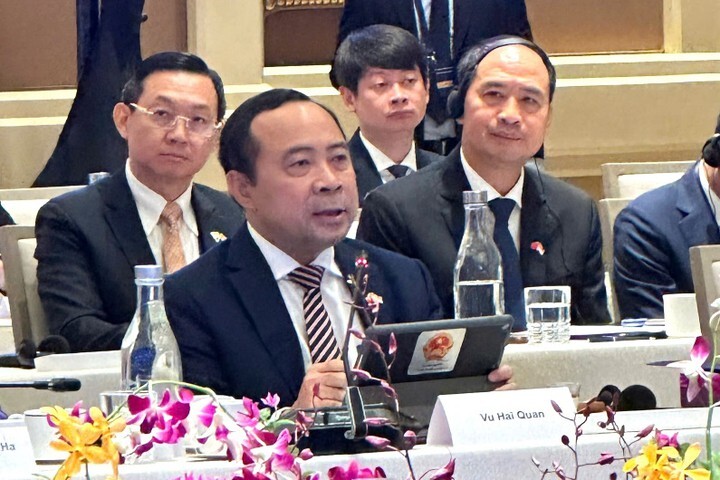
Minister Vu Hai Quan speaks at the Dialogue.
According to Minister Vu Hai Quan, the answer lies in science, technology, innovation, and high-quality human resources.
Viet Nam is implementing Politburo Resolution No. 57, which identifies science, technology, innovation and digital transformation as key drivers for renewing the growth model.
This also means that we need to move from technology application to technology mastery; from technology transfer to co-creation; from human resource training to joint talent development; and from passivity and dependence to greater self-reliance and self-strengthening.
Self-reliance does not mean doing everything by ourselves.
Self-reliance means having the capacity to choose and master key technologies, while deeply collaborating with trusted partners to jointly create new values.
Singapore is precisely such a partner.
Singapore has strong capabilities in technology, research, governance, finance, global connectivity and talent development.
Viet Nam has a large market, a young workforce and growing manufacturing capabilities, together with important strategic advantages in food security, energy, development space and the potential to expand into new markets.
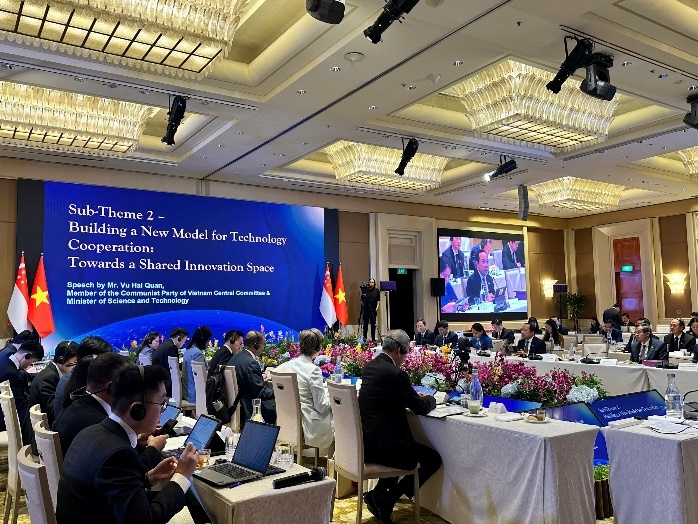
Overview of the Dialogue
Both countries do not compete to do the same things, we complement each other to achieve greater things.
From that perspective, Minister Vu Hai Quan proposes three breakthroughs for the new phase of cooperation.
The First Breakthrough: Upgrading VSIP - from an industrial park to a technology ecosystem
Next-generation VSIPs need to be more than just greener and smarter; they must become engines of technological capability. Within each VSIP, we can establish R&D centers, laboratories, testing facilities, training hubs, tech companies, and startups—turning them into "living labs" to test industrial AI, robotics, smart manufacturing, logistics, clean energy, and green technology.
We need to transform VSIP from a place that "hosts factories" to a place that "builds technological capabilities."
The Second Breakthrough: Building the "Triple Helix" Model - The Government, VSIP and National Universities
It is essential to establish a collaborative framework involving the Government, VSIP, NUS, NTU, and Viet Nam's two National Universities.
VSIP provides businesses, real-world challenges, and market access.
NUS and NTU bring international expertise, research capabilities, and a global network.
VNU-Hanoi and VNU-HCM contribute human resources, research capacity, and Viet Nam's innovation ecosystem.
Both governments shape the institutional framework and supply initial funding.
Enterprises from both nations engage directly from the beginning.
Not merely Vietnamese students studying in Singapore or Singaporean experts doing the training in Viet Nam, this initiative advances toward: joint faculty research, co-supervised doctoral candidates, jointly operated laboratories, problems solving faced by industry, and the co-development and commercialization of products.
This marks a strategic shift from university-level collaboration to a deep integration across university, technology, and corporate ecosystems.
The Third Breakthrough: Jointly Leading Digital Transformation
This is an area where Minister Vu Hai Quan believes Viet Nam and Singapore can leave a highly tangible mark. General Secretary To Lam raised the initiative to integrate Viet Nam's electronic identification system (VNeID) with Singapore's digital identity framework. This initiative transcends a mere technological platform; it represents a strategic vision - the connection of the two nations within a shared digital space, paving the way for seamless integration across the entire ASEAN block.
Viet Nam seeks to learn from and share experience with Singapore - a nation currently ranked third globally in the E-Government Development Index - in building digital government, digital data, public services, and digital governance, with a particular focus on data governance frameworks and AI transformation.
Simultaneously, Viet Nam desires to collaborate with Singapore to design training programs for Vietnamese officials in digital transformation and tech governance.
As a concrete next step this October, the Ministry of Science and Technology, alongside Singaporean partners, will launch a capacity-building program on science, technology, innovation, and digital transformation governance for leadership teams across 34 provincial and municipal Departments of Science and Technology.
These three strategic directions aim for a grander transformation:
From economic connectivity to technological connectivity.
From technology transfer to co-creation.
From workforce training to joint talent development.
From bilateral cooperation to jointly creating value for ASEAN and the world.
Both countries need to redefine how the success of their cooperation is measured, namely:
How many technologies have been co-developed?
How many products have been jointly commercialized?
How many talents have been nurtured together?
And how much new value has been created for the citizens and businesses of both nations?
These metrics define a true Comprehensive Strategic Partnership in the technology era./.
